New Choral Music in Classic Styles
by Peter Bird of Los Angeles

[Peter Bird]     [contact]     [Johannes Ockeghem]

CONTENTS
Biography
My Compositions
A History of Choral Music
Choral-Music Puzzlers
Recommended Links


Biography: Born 1951. Amateur choral singer since 1964, under direction of Yuko Hayashi, Henry Weigel, Carol Keiser, Susan Rosenstein, Colleen Cronin, David Simmons, Julia Tai, and Jenni Brandon. Geophysicist since 1972; professor at UCLA since 1976. Amateur composer of choral music since 2004.


My Compositions: (Newest on top. All works are free, with full details in the Terms of Use page.)

15. Mars (a secular cantata in 4 parts)

15a. Mars: 1. Waiting for rain

Download: PDF     MIDI (20 KB)     MP3 (6 MB)     Sibelius5

Text:
Waiting, waiting for rain...
Where there is no rain, there is no life.
Where there is no life, there is no death.
Where there is no death, there is no time.
Waiting, waiting for rain...
Waiting, waiting for time.

Musicians: SATB chorus (sometimes divisi), flute, and vibraphone.

Style: Renaissance requiem; Baroque homophony & canon.

Length: 6 minutes.

15b. Mars: 2. Roving the wasteland

Download: PDF     MIDI (18 KB)     MP3 (4 MB)     Sibelius5

Text: The communications of 2 Mars Excursion Rovers are translated into English.

Musicians: T solo, S solo, flute, and piano.

Style: Greek dances.

Length: 4 minutes.

15c. Mars: 3. Spring upon the ice

Download: PDF     MIDI (71 KB)     MP3 (7 MB)     Sibelius5

Text: The soloists represent a pair of astronauts, while the chorus represents the environment.

Musicians: B solo, S solo, SATB chorus, flute, piano, and vibraphone. The soloists should feel free to use microphones.

Style: A scene from an opera.

Length: 8 minutes.

15d. Mars: 4. A small golden plaque

Download: PDF     MIDI (20 KB)     MP3 (4 MB)     Sibelius5

Text:
Old ones, forgive our footprints.
Forgive our cairns of trash.
Our noise and vapors swirl away
and leave these words at last:
We did not come for glory
or for material needs;
We came to learn your story
and carry home the seeds.

Musicians: SATB chorus (sometimes divisi), flute, and vibraphone. If string players are available at the concert, they should be asked to double the vocal parts in this finale.

Style: American primitive.

Length: 4 minutes.

Total length of this cantata: 22 minutes.

14. Mountain stars

Download: PDF     MIDI (21 KB)     MP3 (4 MB)     Sibelius5

Text: A new poem of 4 stanzas describing the experience of really seeing all the stars for the first time, from some place high in the mountains, on a crisp moonless night.

Musicians: SSAA chorus (sometimes divisi) and piano.

Length: 4 minutes.

Style: The choral equivalent of a Renaissance dance.

Inspiration: "Salimmo su`, el primo e io secondo, tanto ch'i' vidi de le cose belle che porta 'l ciel, per un pertugio tondo. E quindi uscimmo a riveder le stelle." [Dante]

13. Mountain streams

Download: PDF     MIDI (30 KB)     MP3 (6 MB)     Sibelius5

Dedication: To Gary Snyder.

Text: A new poem of 4 stanzas describing 4 beautiful places progressively higher up a mountain stream. Inspired by memories of trails in New Hampshire, Colorado, Wyoming, and California. In each setting, a resident animal is seen, heard, or inferred.

Musicians: TBarB chorus (sometimes divisi) and piano.

Length: 6 minutes.

Style: Romantic part-song.

Performance suggestions: The wail of the Common Loon (briefly heard in verse 2), and the chirp of the pika (briefly heard in verse 4), are not easily captured in standard musical notation. If you listen past the end of the piece in the .mp3 file, recordings of a pika and a loon are appended for guidance.

12. The Lake Isle of Innisfree

Download: PDF     MIDI (24 KB)     MP3 (5 MB)     Sibelius4

Text: 12-line poem by William Butler Yeats (1892): “I will arise and go now, and go to Innisfree...”

Musicians: Piano; T, A, & S solos; SATB chorus.

Length: 5 minutes.

Style: Romantic.

Program notes: As Yeats wrote in Four Years, he had seriously contemplated the idea of imitating Thoreau and living alone on an island. His sudden recall of this island while standing in a city street led to this poem, which was one of the first in which he loosened his meter and began to find his own voice. For many readers, it also works as a metaphor: for the hope of finding some island of peace and contentment in this life, before leaving it. I hope this choral setting, with several soloists rather than one, will heighten that universality. Each of the 3 stanzas has its own mood and rhythm, which is why I change the time signature from 3/4 to 2/2 to 5/4, and transform the melody and harmony in each.

Performance suggestions: Sing without vibrato. And cherish your pianist.

11. Simeon’s hymn (Nunc dimittis)

A cappella version: PDF     MIDI (13 KB)     MP3 (3 MB)     Sibelius4

Version with organ: PDF     MIDI (20 KB)     MP3 (4 MB)     Sibelius4

Dedication: To Johannes Ockeghem.

Text: Luke 2:29-32 in English (King James version), followed by minor doxology in Latin.

Musicians: SATB chorus, occasionally divisi, with short S descant. Optional organ accompaniment. (Separate organ part follows score in the .pdf file.)

Length: 4 minutes.

Style: Renaissance forms, with gentle pandiatonic harmony and smooth modulations.

Program notes: A companion piece to “Mary’s hymn (Magnificat),” with parallel structure but different melodies. The initial theme introduced by the basses is echoed one bar later by the tenors (canon at the 6th) and also by the altos and sopranos at 1/2 speed and 1/3 speed, respectively (prolation canon). The middle section uses free imitative polyphony and familiar style. The ending doxology repeats the initial canon under Gregorian tone VIIIG.

Performance suggestions: Variations of dynamic are not marked in the score (or used in the MP3 & MIDI files); they are at the discretion of performers. If the organ is used, it may begin at either bar 1 or bar 16/rehearsal A.

10. Mary’s hymn (Magnificat)

Version with organ: PDF     MIDI (29 KB)     MP3 (6 MB)     Sibelius4

A cappella version: PDF     MIDI (20 KB)     MP3 (5 MB)     Sibelius4

Dedication: To Morten Lauridsen.

Text: Luke 1:46-55 in English (King James version), followed by minor doxology in Latin.

Musicians: SATB chorus, occasionally divisi; either a cappella or with organ. (Separate organ part follows score in the .pdf file.)

Length: 6 minutes

Style: Renaissance forms, with gentle pandiatonic harmony and smooth modulations.

Program notes: The initial theme introduced by the sopranos is echoed one bar later by the altos (canon at the 5th) and also by the tenors and basses at 1/2 speed and 1/3 speed, respectively (prolation canon). The middle section uses free imitative polyphony and familiar style, often in a rhythmic pattern of 3-3-2-3-3-4. The ending doxology repeats the initial canon above Gregorian tone VIIIG (one of the set used to chant the Magnificat in Latin).

Performance suggestions: Variations of tempo and dynamic are not marked in the score (or used in the MP3 & MIDI files); they are at the discretion of performers. (But, in this piece, they should be subtle.)

9. An anthem of Earth

Download: PDF     MIDI (59 KB)     MP3 (10 MB)     Sibelius4

Individual MIDI files for learning each part: Soprano   Alto1   Alto2   Tenor   Bass1   Bass2

Dedication: To Jared Diamond.

Text: original; included in the .pdf file, following the full score.

Musicians: SAATBB chorus with organ.

Length: 11 minutes.

Style: Romantic and episodic, with multicultural coda.

Program notes: There are approximately 256 national anthems on our planet, but very few anthems that express the accomplishments, hopes, and problems of people on Earth as a whole, in relation to our environment. It is time to change this. We need simple songs for schools and football fields, and more sophisticated songs for concert halls and churches. Here is my attempt. Of the many names we have for our planet, you will hear four: Dunia (Swahili), Dhara (Sanskrit), Gaea (Greek), and Terra (Latin).

8. A little flock from Iceland

Download: PDF     MIDI (80 KB)     MP3 (16 MB)     NoteWorthyComposer {original edition}     Sibelius5 {revised edition}

Text: Four new poems in English, describing dramatic confrontations in (respectively) ~900 AD, ~950 AD, ~1000 AD, and ~1250 AD. The first two are fiction and the last two are based on historical events. English words that have Icelandic cognates, or at least Norse or Germanic origins, are used as much as possible.

I. Lón: An Irish woman, just brought to Iceland, sings to the swans who have made the same crossing.

II. Grímsvötn: A volcanic eruption under the icecap angers the gothi.

III. Vestur Grǽnland: Leif Eiriksson rescues the shipwrecked Norwegians.

IV. Drangey: Bishop Guðmundur Arason confronts evil on the cliffs of the island.

(full texts of poems may be found in the .pdf file, following the full score.)

Musicians: SATB chorus, short SATB solos, violin, & flute. (Flute & violin parts may be found in the .pdf file.)

Length: 4:55 + 2:42 + 4:07 + 5:25 = 17:07.

Style: Romantic part-songs

Program notes: By mixing conventional and pandiatonic harmony, I hope to convey the awesome beauty of Iceland and Greenland, which is rarely “pretty” in the southern sense. There are allusions to sean-nos and rimur singing, to gothic motets, and to hardangerfelle playing, all of which are regionally appropriate (although possibly anachronistic). However, the overall concept of using a chorus to tell stories is primarily derived from Greece and Italy.

7. Donne’s Hymn

Download: PDF     MIDI (12 KB)     MP3 (3 MB)     NoteWorthyComposer

Dedication: To my father George.

Text: “Since I am coming to that Holy room, where, with Thy choir of saints forevermore, I shall be made Thy music; as I come I tune the instrument here at the door; and what I must do then, think here before.” [First stanza of John Donne’s Hymn to God, My God, in my Sickness, 1631?]

Musicians: SATB chorus, sometimes divisi.

Length: 3 minutes.

Style: late Renaissance.

Program notes: John Donne, now recognized as the greatest of the “metaphysical” poets, was most famous in his lifetime as Dean of St. Paul’s, London. Had his poem been published at the time of his death, it might have been set by Thomas Tomkins (one of the few English choral composers remaining on the eve of the English civil war). Almost 4 centuries later, I attempt a setting that would not offend their ears.

6. John Muir suite

Download: PDF     MIDI (44 KB)     MP3 (9 MB)     NoteWorthyComposer

Text: Four well-known quotes from the prose of John Muir:

N’ascensione madregala: “Climb the mountains, and get their glad tidings....”

Nature her galliard: “Everything is flowing, going somewere... / “How lavish is nature...”

Vespers: “The evening flames with purple and gold...”

Grand canon: “This grand show is eternal. It is always sunrise somewhere...”

(Full quotations may be found on the last page of the .pdf file.)

Musicians: SATB chorus, violin*, & flute* [*or equivalent organ stops]

Length: 2:42 + 2:04 + 2:44 + 2:30 = 10 minutes.

Style: Renaissance.

Program notes: John Muir was effectively engaged in his own time as the prime advocate for appreciation and preservation of wilderness. But in his outdoor aspect as a wandering sadhu, he developed a consciousness of "deep time" which is measured in sequoias, ice ages, and even orogenies. Instead of setting his words in a contemporary style (e.g., Brahms, Verdi, or ragtime), I have emphasized the eternal part of his message by using our earliest secular models, those of the Renaissance. Here are a madrigal, a galliard, a vespers anthem, and a canon, which outline one glorious mountain day: morning ascent, afternoon in an alpine meadow, sunset, and philosophising by the campfire.

5. To The House

A cappella version: PDF     MIDI (15 KB)     MP3 (4 MB)     Sibelius4

Version with organ: PDF     MIDI (22 KB)     MP3 (4 MB)     Sibelius4

Dedication: To my grandfather Peter Forgue, an artist in wrought iron, who also hand-built a house by the sea.

Text: Poem “To The House” by Robinson Jeffers. Used by permission. Text and copyright notices may be found in each .pdf file, following score.

Musicians: SATB chorus, a cappella, or with organ. Separate organ part follows score and text in .pdf file.)

Length: 4:30.

Style: Twentieth-century pandiatonic harmony. Episodic, with four themes for earth/air/fire/water; earth & water combine in finale.

Program notes: Robinson Jeffers and his wife Una moved in 1914 to Carmel, California, at the north end of the rugged Big Sur coast. Here he would build Tor House (and later, Hawk Tower) from granite on the site, and celebrate the work with this poem that invokes the four classical elements of earth, air, fire, and water.

4. Pushkin’s “Reverie”

Download: PDF     MIDI (23 KB)     MP3 (6 MB)     NoteWorthyComposer

Text: Untitled 8-verse poem by Aleksandr Sergeevich Pushkin, 1829. (May be sung either in English or in Russian.)

Musicians: Unaccompanied SATB chorus, B & S solos.

Length: 6:30

Style: Romantic

Program notes: Pushkin describes how thoughts of the inevitability of death intrude into his daily life. By the end, he achieves acceptance, or at least resignation, by visualizing his tomb and himself at rest. This poem is doubly poignant: First, Pushkin actually died young, in a duel to defend the honor of his wife. Second, because Pushkin had difficult relationships with both the government and the orthodox church, his funeral was private and hurried. Following 6 verses set to original melodies, I set the last two verses as solo descants against the traditional hymns “Holy, Holy, Holy” and “Eternal Memory.” In Pushkin’s time, the singing of the former might have been permitted even for the heterodox. The latter hymn was clearly in his mind, as shown by the echo of “Вєчная память” in his final words “вєчною сиять.”

3.Into the Twilight

Download: PDF     MIDI (14 KB)     MP3 (6 MB)     NoteWorthyComposer

Text: 16-line poem “Into the Twilight” by William Butler Yeats, 1893.

Musicians: SATB chorus, S solo, violin*, & flute* [*or equivalent organ stops]

Length: 4:15

Style: Irish Romantic

Program notes: The poem and the music go through mood swings as Yeats contrasts his conflicted modern life with the consolation he finds in the lore and landscape of ancient Ireland.

2. Cædmon’s Hymn

Download: PDF     MIDI (24 KB)     MP3 (5 MB)     NoteWorthyComposer

Text: 9-line fragment of a hymn by Cædmon (CAD-mun) circa 660 A.D.. Sung first in the West-Saxon dialect of Anglo-Saxon, then in Latin, and finally in Modern English. A pronunciation guide for the Anglo-Saxon part is attached at the end of the score, and Project Gutenberg also offers an on-line recording.

Musicians: SATB chorus a cappella, baritone solo, triangle(s)/chime(s)/bell(s) on d” and/or d”’. Doubling with organ or strings may be helpful, unless the chorus is large.

Length: 7:45

Style: solo, chant, organum, motet, anthem, & canon

Program notes: The tune and most of the words of Cædmon’s famous hymn have been lost; this fragment of the text was recorded by the Venerable Bede. In this setting, the message and the musical theme are preserved through many changes of form as the language and the musical style gradually progress from those of the early Middle Ages to those of the English Restoration.

First performance: Morgana Madrigaalkoor, Den Haag, June 2009, under direction of composer Taco Sorgdrager.

Nota Bene: Cædmon took his subject from the book of Genesis. But, by setting his words to music, I did not intend to endorse “creationism” or “intelligent design” of organisms. In fact, I teach the scientific theory of biological evolution (as described in this one-page summary). However, the ultimate origin of the mass-energy of the universe, and its physical laws, remains a subject full of mystery and wonder.

1. Gloria in excelsis Deo

Download: PDF     MIDI (13 KB)     MP3 (3 MB)     NoteWorthyComposer     Sibelius5

Individual MIDI files for learning each part: Soprano   Alto   Tenor   Bass

Text: “Gloria in excelsis Deo, et in terra pax hominibus bonae voluntatis. Laudamus te, benedicimus te, adoramus te, glorificamus te.”

Musicians: SATB chorus a cappella. Organ/piano reduction included.

Length: 3:15

Style: early Baroque

Program notes: An attempt to combine the self-sufficient polyphony of the Renaissance with the smooth modulations of the Baroque. The familiar Latin text includes the angels’ song following the announcement of the birth of Jesus (from Luke) and a joyful response by the people (as in the great doxology).

First performance: The Concert Singers, Los Angeles, December 2006, under direction of composer Jenni Brandon.


A History of Choral Music:

Download: JPG     PDF     AdobeIllustrator

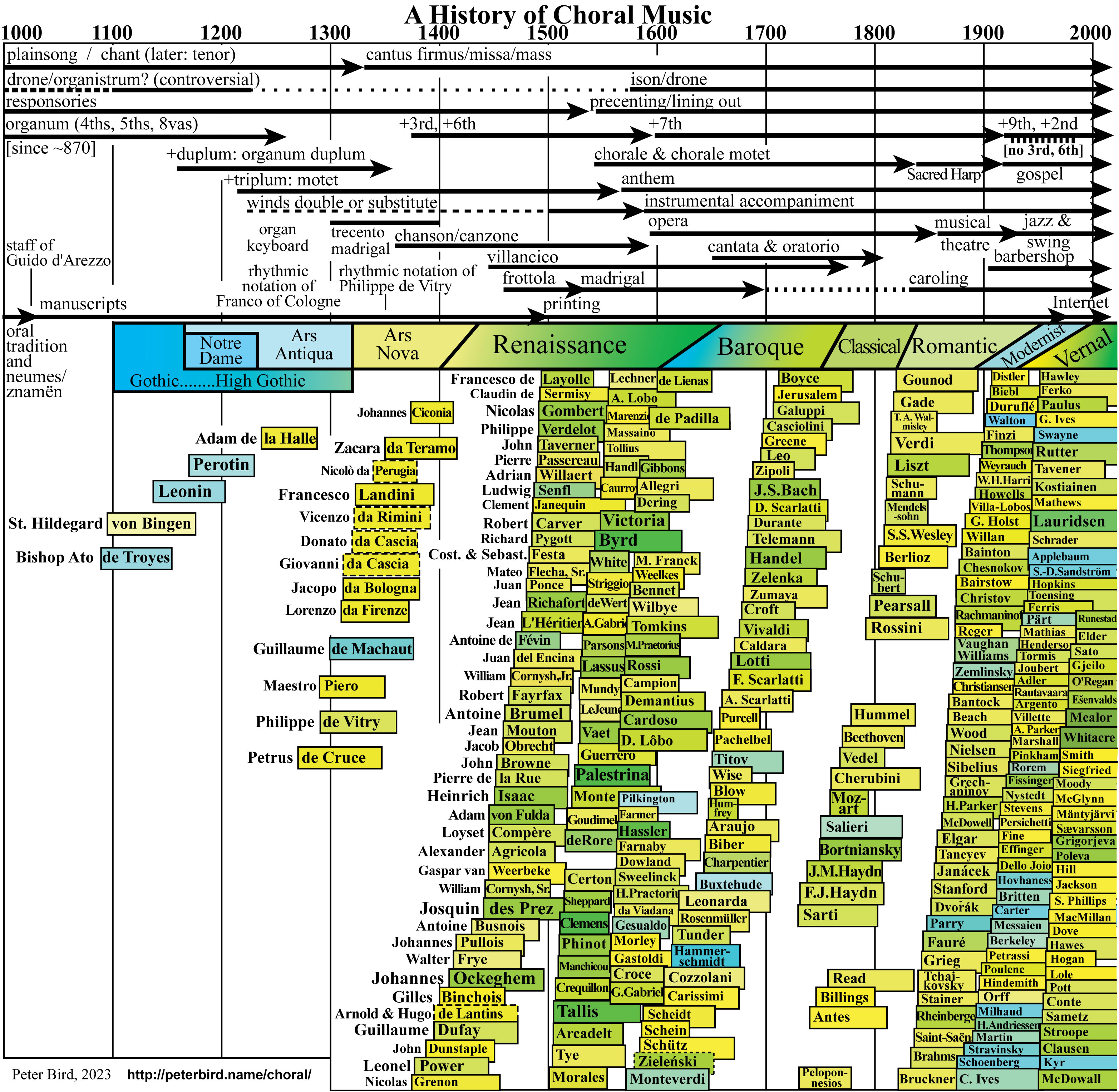
Below is a one-page chart summarizing the history of western choral music since 1000 AD:
A History of Choral Music

This chart gives emphasis to my favorite choral composers, including Tallis, Clemens, Palestrina, Lassus, Byrd, Bortnyansky, Rheinberger, and Lauridsen. However, if you download the Adobe Illustrator version, you will be able to edit it to reflect your own views.

It shows how 6 centuries of accelerating development (1000-1600) was interrupted by three crises. The first crisis was the success of the Reformation, which resulted in a tendency to fundamentalism in the new churches, budget-tightening in the Roman church, and the diversion of princely support to politically safe and newly fashionable Baroque orchestras. (The Thirty Years War, begun in 1618, was the final blow.) The second crisis was the interruption in the training of new composers during the upheavals of the American and French revolutions and the Napoleonic wars. The third crisis was a sociological one, at the opening of the 20th century, when many composers were inspired to reject all the old ways and become “Modernist.” At the same time, the Russian revolution nearly destroyed their national tradition.

Now, we have unprecedented access to the masterworks of the past. The combination of ancient frameworks (e.g., tonality & counterpoint) with modernist- and jazz-inspired freedom in harmony and form has given rise to a new era in choral music. What shall we call this new period? (Not “Postmodern,”certainly; that term already has different connotations.) We in the choral music community should propose a name for the next period in classical music, as we are somewhat ahead of our orchestral cousins in reasserting the eternal value of tonality, melody, harmony, and structure to create an emotionally or spiritually coherent message. (At the same time, we are not merely reactionary, but open to expanded harmonies, exciting rhythms, diverse texts, and multiple cultural traditions.)


Choral-Music Puzzlers:

1) There are many pairs of choral composers who share(d) the same surname. If we allow for variant spellings, there are 11 cases in my historical chart above. (Any family group of more than 2 composers still counts as one case.) The more comprehensive composer list at the Choral Public Domain Library includes 90 more cases, for a total of 101! How many can you think of, without looking? {solution}

2) The two composite images below represent one of my all-time favorite choral compositions, a model of effortless grace and charm.
The large composite image represents the title and (metaphorical) subject of the work.
The small composite image represents its composer:

[title & subject]     [composer]

If you can solve this, your prize is that you can go to the Choral Public Domain Library and download a free score, and add this work to your group's library!


Recommended Links:

Choral Public Domain Library (over 10,000 free downloadable choral scores from over 1400 composers, mostly typeset, some with MIDI previews)

International Music Score Library Project (over 21,000 free downloadable instrumental & choral scores; most are scans)

ChoralNet (news, views, & links about choral singing)

The Concert Singers (the chorus of dedicated amateurs in Los Angeles that I sing with)

Jenni Brandon (our director, and a serious composer)

Or, perhaps you were not looking for choral music, but instead want to find my geological web page?
